
The thesis
Why insider buying is one of the most studied edges in finance
The foundational truth is simple: corporate insiders know more about their company than anyone else on earth. They see the order book, the pipeline, the margins, and the catalysts months before the public does. They’re legally barred from trading on material non-public information — but they’re free to act on their informed judgment about whether the market is mispricing their company. And when they buy with their own after-tax dollars, that judgment is expensive to fake.
The academic record is unusually consistent on this point:
- Insider purchases predict positive abnormal returns. Lakonishok & Lee (2001) found heavy-insider-buying firms outperformed heavy-selling firms by roughly 7–8% over the following year. Jeng, Metrick & Zeckhauser (2003) estimated insider purchases earn on the order of 6%+ annualized abnormal return — while insider sales carry almost no signal.
- Most of the move happens fast. A large share of the abnormal return accrues within the first days to weeks after the trade is disclosed — the edge is timely, and it decays.
These are not Insider Alpha’s results; they are the published, replicated base rates the technology is designed to filter for and surface. (Sources: Lakonishok & Lee, RFS 2001; Jeng, Metrick & Zeckhauser, REStat 2003; Seyhun, JFE 1986.)
The problem
99% of insider filings are noise
If insider buying is such a clean signal, why doesn’t everyone capture it? Because the raw feed is mostly junk. Routine, pre-scheduled, and token purchases swamp the genuinely informed ones. A naive “buy everything insiders buy” approach earns close to the market with worse drawdowns — in our own data, the average insider purchase has a positive mean but a near-zero median and a sub-coin-flip win rate. The returns are right-skewed: a minority of high-conviction buys carry the entire edge, and the rest dilute it.
The entire game is selection. Insider Alpha’s value isn’t in tracking insider buying — dozens of free tools do that. It’s in the filtering: discarding the ~99% that don’t matter and acting only on the conviction signals that do.
The signal
The Insider Alpha conviction model
A Form 4 purchase becomes a tradeable Insider Alpha signal only when it clears every one of these gates — each chosen because the research, and our own out-of-sample testing, shows it concentrates the edge.
Open-market purchase
Transaction code “P” — an insider deploying personal capital, not an option grant, award, or automatic plan. Real money, real conviction.
High conviction
At least one of: the buyer is the CFO (the insider role with the strongest forward returns in our historical analysis); a cluster of ≥3 distinct insiders buying within ~5 trading days; or a stake increase of ≥50%.
First-time buyer
The insider’s first purchase in that name in the lookback. Initiations carry the signal; repeat / averaging-down buys are mostly noise — a result that held in both halves of the data.
Tradeable
Share price ≥ $5 and filing-day dollar volume ≥ $1M. The discipline most backtests skip — it removes illiquid micro-caps that look spectacular on paper but can’t be traded at size.
Material size
Aggregate purchase value ≥ $25,000. No token buys — the purchase has to be big enough to mean something.
What the data says about the gates. In our hypothetical 30-day-forward analysis of ~30,000 buys (gross of costs), CFO purchases were the single strongest feature — a mean forward return roughly 3× the field — with stake-increase and cluster buys close behind, exactly the factors the model gates on. Each rule maps to a documented effect, so the model is built on hypotheses with prior out-of-sample support — not curve-fitting.
From signal to trade
How a signal becomes a trade you place
Look-ahead-safe entry. You can’t act on an insider’s trade date — you don’t know until they file. The model anchors to the opening price of the next session after the filing posts, the only convention that’s honestly tradeable.
Disciplined hold. Positions are held three trading days by default and exited at the close — a window that, in the backtest, captured the bulk of the observed move while recycling capital quickly.
Diversified sizing. Up to twelve equal-weight positions (~8% each), prioritized CFO first, then stake-increase, then cluster. Many small positions — never a handful of concentrated bets — because the signal is right-skewed, and in the backtest a diversified book is what captured it.
You’re always in control. Insider Alpha stages each qualifying signal as a proposed trade in your portal. You review it and confirm it yourself — nothing is placed until you do. The technology surfaces and prepares; the decision is always yours.
The “+” overlay
Insider Alpha + : idle capital, intelligently deployed
A short-hold insider book leaves capital idle most of the time. Rather than let it sit dead, Insider Alpha + can propose deploying idle cash into a 3× S&P 500 ETF (UPRO) when its volatility gate reads risk-on — staged for you to review and confirm like any other trade. The technology never moves your cash on its own. The gate works like this:
When the S&P 500 is above its 200-day moving average andthe VIX is calm (< 22), the gate flags conditions as risk-on and may surface an overlay proposal; otherwise it surfaces none. You decide whether to act. In the study window, ~71% of days qualified as risk-on.
Be clear about what the “+” is. With short holds, most capital is typically in the overlay on a given day — so the overlay is a leverage amplifier, not the source of the edge. The insider signal is the alpha; the overlay is beta with a risk switch. We present both separately below, and you decide whether to use it.
The evidence
What the backtest shows
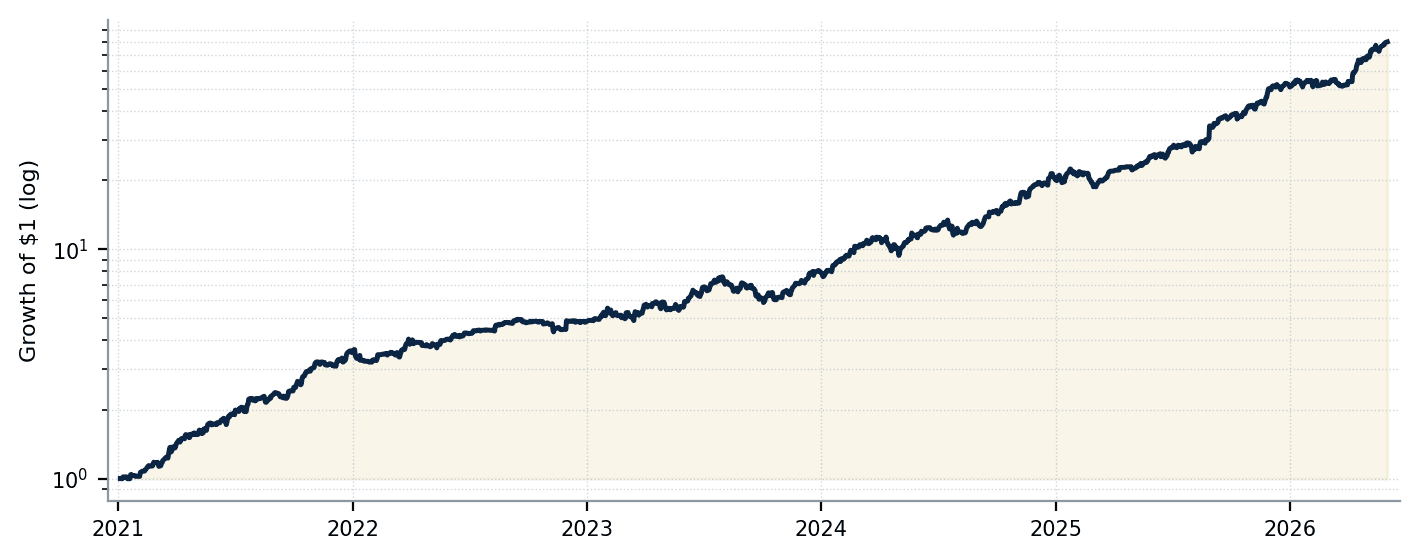
Every SEC Form 4 open-market purchase from January 2021 through 2026 — ~51,600 filings, of which ~30,000 had sufficient price history to analyze — sourced from SEC EDGAR and joined to daily prices. Returns are computed look-ahead-safe (next-open entry). Figures below are hypothetical and, unless noted, gross of commissions, slippage, and financing.
The ≈ +125% figure is leverage-amplified. See “the honest decomposition” below for the signal-only ≈ +27–32%.
The flagship result is consistency, not the headline number
The core CFO signal returned essentially the same in the years used to design it and the untouched years that followed — the signature of a real edge, not an over-fit artifact. (Hypothetical out-of-sample CAGR, 3-day hold, gross of costs.)
| Filter | In-sample ’21–’23 | Out-of-sample ’24–’26 |
|---|---|---|
| All insider buys | +4% | +17% |
| CFO purchases (core signal) | +27% | +27% |
| Cluster (≥3 insiders) | +14% | +60% |
| Ownership increase ≥100% | +32% | +51% |
| Insider Alpha conviction composite | +27% | +27% |
Signal vs. signal-plus-overlay vs. the market
| Strategy (hypothetical) | CAGR | OOS | Max DD |
|---|---|---|---|
| Insider Alpha (signal only, diversified) | ≈ +27% | ≈ +32% | ≈ −37% |
| Insider Alpha + (signal + gated overlay) | ≈ +125% | ≈ +162% | ≈ −23% |
| S&P 500 (SPY) — reference | ≈ +15% | — | ≈ −25% |
| 3× S&P (UPRO) buy & hold — reference | ≈ +34% | — | ≈ −75% |
Benchmark rows (SPY, UPRO) are price / total return over the same window; the strategy rows are hypothetical and gross of costs — not directly comparable on a net basis.
The honest decomposition
The headline Insider Alpha + figure is dominated by the leverage overlay, which compounded a strong 2021–2025 equity market while the trend/VIX gate sidestepped the 2022 drawdown. The insider signal’s own contribution is the ~+27–32% line. The overlay is the amplifier; the signal is the edge. All figures are gross — net of real-world costs and slippage, results are materially lower.
Durability
Why the edge is structural, not lucky
It survives out-of-sample
Rules were set on 2021–2023 and tested, untouched, on 2024–2026. The core CFO signal performed essentially the same in both — the single most important test a strategy can pass.
It’s grounded in independent research
Every gate maps to a documented, peer-reviewed effect: opportunistic-vs-routine filtering, cluster buying, CFO informativeness, and conviction sizing. Theory predicts it; fresh data confirms it.
It is ruthlessly selective
Out of tens of thousands of filings, fewer than 1% ever become signals. The edge lives in the rejection, not the inclusion.
It is regime-aware
The model reads market context — trend and volatility — rather than assuming one playbook works everywhere, and it explicitly de-risks the leverage overlay when conditions turn.
It removes human emotion
No discretion, no FOMO, no holding losers. The same rules, applied identically, every trading day.
Rigor
How the technology is validated
Look-ahead safety
Features use only data available at the filing; entry is the next session’s open. Using the trade date instead (a common error) inflates returns — Insider Alpha does not.
Walk-forward testing
Rules are fit on early data and judged on later, untouched data, with degradation expected and haircut accordingly.
Robustness over peak
Preference for rules whose performance is stable when thresholds are perturbed — not knife-edge settings that won’t repeat.
Cost sensitivity measured
The engine quantifies how the edge degrades as trading costs rise — which is why the deployable default is the more cost-tolerant 3-day hold.
Limitations disclosed
Survivorship (delisted names excluded from historical data) and gross-of-cost reporting both flatter the raw backtest. Live results will be lower.
The platform
Built to run live, securely
- Real-time SEC ingestion. Monitors EDGAR for new Form 4 filings every trading day and scores them against the conviction model automatically.
- You review and confirm. The engine stages the day’s qualifying signals as proposed trades; you review each one and place it yourself. Nothing trades until you confirm it — the platform never trades on your behalf or exercises discretion.
- Secure brokerage connection. You link your own brokerage account through a secure OAuth flow. Insider Buys never sees or stores your password or raw API keys, and never takes custody of your money.
- Controls built in. Per-account allocation limits, a pause switch, full audit logging, and a paper-trading mode so you can watch the strategy before committing real capital.
Risks
Risks you should understand
Leverage
The Insider Alpha + overlay uses a 3× ETF, which carries large, rapid drawdowns and daily-reset decay in choppy markets. Leverage magnifies losses as well as gains.
Hypothetical performance
Backtested results have inherent limitations, do not represent actual trading, are gross of costs, and benefit from hindsight.
Costs & turnover
Short holding periods mean frequent trading; commissions, spreads, and slippage reduce returns — potentially substantially.
Survivorship & regime
Historical data excludes delisted names; the overlay benefited from a strong 2021–2025 market and would perform differently in adverse regimes.
Capacity
The edge concentrates in smaller, less-liquid names, which limits how much capital the strategy can deploy.
No guarantee
Past and simulated performance is not indicative of future results. Investing involves risk, including loss of principal.
Appendix
Glossary
- Form 4
- The SEC filing insiders must submit within two business days of trading their own company’s stock.
- Transaction code “P”
- An open-market purchase — the conviction signal — distinct from grants, awards, or automatic-plan trades.
- Cluster buy
- Multiple distinct insiders buying the same stock in a short window.
- 200-day moving average / VIX
- The trend and volatility measures used to gate the leverage overlay (risk-on only above the 200-DMA and with the VIX calm).
- Look-ahead-safe
- Using only information available at decision time; entering at the next session’s open after a filing.
- Out-of-sample
- Data deliberately withheld while the rules are designed, used to test whether the edge is real.
Important — Hypothetical Performance Disclosure
The performance shown is hypothetical and backtested, derived from the simulated application of the Insider Alpha methodology to historical data. It does not represent actual trading and has inherent limitations, including hindsight bias and the absence of real-time execution and liquidity. Results are gross of commissions, slippage, financing/borrow, market impact, and taxes, which would reduce returns. “Out-of-sample” denotes data withheld during rule selection and is not a guarantee of future efficacy. Leveraged ETFs involve substantial risk and are generally intended for short holding periods. This material is for informational purposes only and is not investment advice, an offer, or a solicitation. Past and simulated performance is not indicative of future results. Investing involves risk, including loss of principal. Insider Buys is a research and decision-support tool — not a broker-dealer or investment adviser. See our Risk Disclosure, Terms, and Privacy Policy.
See what insiders are buying.
Insider Alpha does the digging through thousands of SEC filings and surfaces the ones that clear its rules. You review each one and decide for yourself whether to place it.
Get started